Friday, May 28, 2010

What do you SEE?

"When you're holding your camera and peering through the viewfinder, what is it that you see?"

I'm repeatedly asked this question (or some variant of it) by students and viewers of my work, all wondering how I get from what I'm looking at, to what I see. Since I work almost exclusively in black and white, my finished images are always significantly different than what is actually in front of me.

Pre-visualization. Visualize the scene in front of you as it is going to be when you are done, not as it appears in front of you. It's much easier to get to your destination if you know where you are going. If you don't have a specific destination, it's too easy to get sidetracked or end up someplace good, but not great. Once you know what you want a given scene to look like, then go about planning on how to get it there.

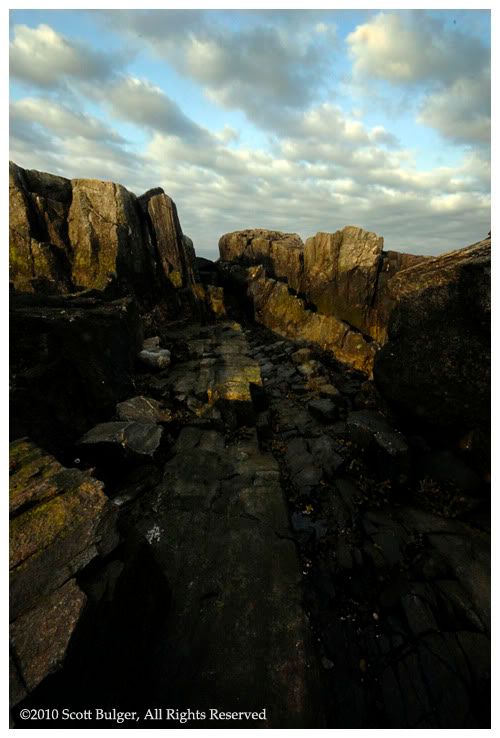
This is what was in my viewfinder when I set up the camera on the tripod.
©2010 Scott Bulger, All Rights Reserved

This is what I have in my mind BEFORE I ever trip the shutter.
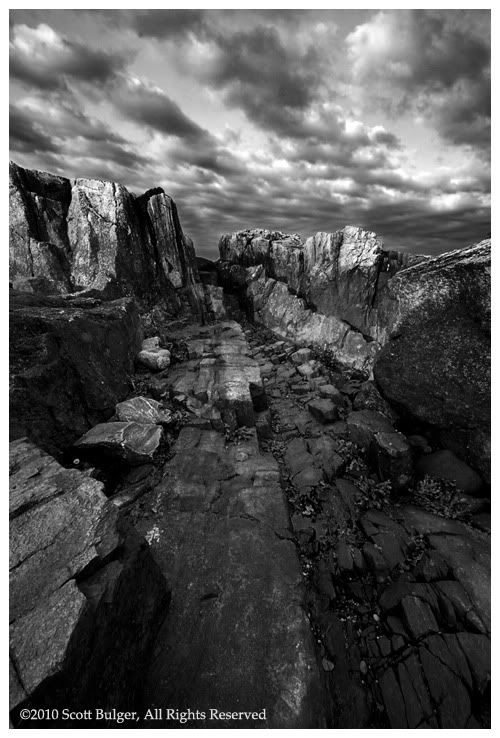
©2010 Scott Bulger, All Rights Reserved

Don't rely on happy accidents to create a beautiful image. Be meticulous in your planning.
  • Know where the light is and the effect it's going to have on your subject. Don't go out at high noon on a cloudless day and complain about the shadows and the unbearable contrast. Set your alarm clock and get out of bed while it's still dark if necessary.
  • Choose the appropriate lens to gain the point of view, proportions, and relationships between objects that you are attempting to obtain.
  • Get your camera off of "Automatic". Take control of both your shutter speed and your aperture.
  • Choose the appropriate aperture to get the depth of field that you want, and combine that with a shutter speed that will control any motion in your image and have it displayed the way you want it. Your options can be limited here either by your equipment or by the current lighting conditions.
  • Use your ISO setting and/or neutral density filters to compensate your exposure. It's not just a simple nod to reciprocity anymore.
  • Bracket your exposures. The better exposure you start with, the easier it is going to be to get to your destination.
  • Understand what post-processing you are going to be able to do and how it will affect your image. We aren't talking about HDR here, just some levels, curves, dodging, and burning. Simple darkroom techniques.
So know where you want to go, and know how you are going to get there. It makes it a much nicer ride when you safely arrive at your destination.

Wednesday, May 26, 2010

Khronikos

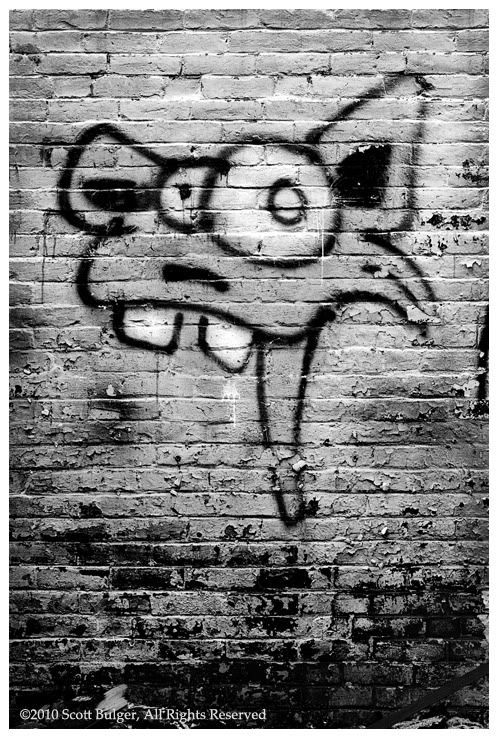
Exopthalmus, ©2010 Scott Bulger, All Rights Reserved
Exopthalmus, 2009

In conjunction with the release of my second book of photographs, "Khronikos", the Carolyn Jenkins Gallery on the campus of the Kimball-Jenkins Estate on Concord, New Hampshire, will be hosting an exhibit of new work from the book. A selection of seventeen 20" x 30" fine art digital prints will be on display beginning July 1st and running through August 27th. An opening reception will be held on Friday night, July 9th, from 7:00 PM - 11:00 PM. Music will be provided by the Scott Solsky Quartet. Look for a review of the exhibit in the upcoming June issue of Art New England magazine.

“Khronikos” is from the Greek for “Chronicle”. A “Chronicle” is a historical account of facts and events arranged in chronological order. Typically, equal weight is given for historically important events and local events, the purpose being the recording of events that occurred, seen from the perspective of the chronicler. Since these events are seen from the perspective of the chronicler, they are open to interpretation. Scholars categorize the genre of chronicling into two subgroups: live chronicles, and dead chronicles. A dead chronicle is one where the chronicler collects his list of events up to the time of his writing, but ignores further events as they occur. A live chronicle is where one or more authors add to a chronicle in a regular fashion, recording contemporary events shortly after they occur. Because of the immediacy of the information, historians tend to value live chronicles over dead ones. Chronicles are the predecessors of modern "time lines" rather than analytical histories. They represent accounts, in prose or verse, of local, national, or worldwide events over an extended period of time, the lifetime of the individual chronicler, and often several subsequent chroniclers.

Time is the thread that binds these photographs together.

Friday, May 21, 2010

Art is Not for the Timid

©Scott Bulger 2010, All Rights Reserved

Once there lived a village of creatures along the bottom of a great crystal river. The current of the river swept silently over them all--young and old, rich and poor, good and evil, the current going its own way, knowing only its own crystal self.

Each creature in its own manner clung tightly to the twigs and rocks of the river bottom, for clinging was their way of life, and resisting the current what each had learned from birth. But one creature said at last, "I am tired of clinging. Though I cannot see it with my eyes, I trust that the current knows where it is going. I shall let go, and let it take me where it will. Clinging, I shall die of boredom."

The other creatures laughed and said, "Fool! Let go, and that current you worship will throw you tumbled and smashed across the rocks and you will die quicker than boredom!" But the one heeded them not, and taking a breath did let go, and at once was tumbled and smashed by the current across the rocks.

Yet in time, as the creature refused to cling again, the current lifted him free from the bottom, and he was bruised and hurt no more. And the creatures downstream, to whom he was a stranger, cried, "See a miracle! A creature like ourselves, yet he flies! See the Messiah, come to save us all!"

And the one carried in the current said, "I am no more Messiah than you. The river delights to lift us free, if only we dare let go. Our true work is this voyage, this adventure." But they cried the more, "Savior!" all the while clinging to the rocks, and when they looked again he was gone, and they were left alone making legends of a Savior.

Excerpt from "Illusions: The Adventures of a Reluctant Messiah" by Richard Bach

Sunday, May 16, 2010

Where do We Draw the Line?

©Scott Bulger 2010, All Rights Reserved
“One final paragraph of advice: Do not burn yourself out. Be as I am-a reluctant enthusiast… a part time crusader, a half-hearted fanatic. Save the other half of yourselves and your lives for pleasure and adventure. It is not enough to fight for the land; it is even more important to enjoy it. While you can. While it is still there. So get out there and mess around with your friends, ramble out yonder and explore the forests, encounter the grizz, climb the mountains. Run the rivers, breathe deep of that yet sweet and lucid air, sit quietly for a while and contemplate the precious stillness, that lovely, mysterious and awesome space. Enjoy yourselves, keep your brain in your head and your head firmly attached to your body, the body active and alive, and I promise you this much: I promise you this one sweet victory over our enemies, over those deskbound people with their hearts in a safe deposit box and their eyes hypnotized by desk calculators. I promise you this: you will outlive the bastards.” Edward Abbey

Sunday, March 21, 2010

Don't Get Caught Up With What You Don't Have

When working on my first book back in 2001, I was traveling through the jungles of the Yucatan Peninsula of Mexico photographing the people that lived in many of these tiny villages. I spent a good part of one day with a family of four in a tiny village that I can't even begin to remember the name of. There was no electricity or running water. If it rained, the family caught water in a cistern and it was gravity fed through a pipe into the house where they could turn it on for as long as it lasted. If they wanted the water to be anything other than the temperature it was outside, they heated it over an open fire. Cooling it was pretty much out of the question. There was no ESPN, or television of any kind. No Nintendo or Playstation, no internet, no heat or air conditioning, no Transformers or Legos. They had hammocks to sleep in and when they all woke up, the hammocks were unhooked so that the house was one 12' x 12' open room. They were all happy. The kids ran around, played with sticks, and laughed.

Last week, when temperatures here were finally reaching a tolerable level of 60+ degrees during the day, my youngest son (we'll call him "Ansel", who is quickly closing in on 6 years old) spent the better part of two days playing outside with sticks, chalk, and rubber bands. Ansel has Nintendo, Legos, a bicycle, trains, tv, and the internet, yet he chose to use his imagination and make due with less. He decided he wanted a fair, so he went about creating a fair in the yard. He segmented the yard into all of the different midway attractions, creating an archery booth, a slingshot booth, a dart booth, and a skee-ball booth. No electronics, just his imagination and some hard work. He was happy. He ran around, played with sticks, and laughed. He made due with what he had available with no infringement on the quality of play.

I hear so many photographers agonizing over how they are going to get the money to upgrade from their D200 to the D300 or the D700. Their equipment becomes a status symbol for them. We've got to keep up with the Jones's. If Nikon or Canon puts out a newer, bigger, faster model, they have to have it or they aren't keeping up with their PPA buddies. First of all, if you can't figure out how to pay for it, it really isn't a wise investment. If you aren't producing enough income to cover the equipment purchase, you have other fish to fry. The argument that a better camera will raise your senior portrait revenue is specious. It won't. Better product and better marketing will increase your senior portrait revenue, neither of which will be aided by a more expensive camera. If you absolutely need to spend more money, spend it on a better lens. This is where you will see the biggest difference in your image quality.

You need the right tool for the right job. Unless you are shooting sports at a higher level than youth rec leagues, you don't need 8 frames per second. What you need to do is improve your timing. Blasting around the t-ball field shooting 8 frames per second is just embarrassing. None of the 5 year-olds are moving that fast. No high school senior moves that quickly either.

Unless you are consistently printing significantly bigger than 8x10, you don't need 12 mp. What you need is to learn how to handle your exposures properly so that you can get the best out of the camera that you have. I spent a long time printing 12" x 18" with a 6 mp D50 and unless you are 8 inches away or examining the print with a loupe, you can't tell the difference between the print from the D50 and the 10 mp D200. And let's face it, no real viewers examine prints to that extreme.

Please folks, stop falling prey to the equipment bug. Study the craft. Better equipment never equals better talent.

Friday, March 19, 2010

Warning: Shameless Self Promotion Ahead

"the Hippo" is New Hampshire's weekly "Local News, Food, Arts, and Entertainment" newspaper. Every year at about this time they publish their "Best of" issue, with the results in about 100 categories being determined by a write in readers poll. I received an email form the Art Editor last week asking me to give her a call because I had won an award in their readers poll. After calling in and speaking with them, they informed me that I had been awarded runner-up in the "Best Visual Artist" category.


I'd like to thank everyone that took the time to fill out this survey and write my name down. It means a lot to me to know that my work has touched you in a way that you would go to this kind of effort to see me recognized.

I'd also like to take a minute to congratulate Sid Ceaser who topped the category. I've been a fan of Sid's "Plastic Erotica" work for a long time and it's nice to see him get recognized as well.

This is shaping up to be another busy year here in New Hampshire. My next big show (Khronikos) opens with a big reception on July 9th from 7:00 - 11:00 pm in the Carolyn Jenkins Gallery at 233 North Main Street in Concord, NH. This is a collection of 17 black and white images printed at 20" x 30" and framed out to 30" x 40". I hope that you all can make it. Stay tuned for more detailed information.

Thursday, January 28, 2010

New Year, New Work, New Post, New Thoughts

It looks like 2010 isn't a passing fad and is here to stay. Much like rap music and wheat bread, I guess I'll just have to accept it. I haven't posted here in several months. I've got lots of reasons, but they would really just be excuses, so I won't bore you with the details. I'm hoping to be posting much more regularly this year.


Spring semester at the college is in full swing. Teaching the digital generation the finer points of film photography is a lot of fun. The look on their faces after agitating their first roll of film and they find images is priceless, and the look that follows when their first print starts coming up in the developing tray is just magical. That's the "A-ha!" moment.

Quote of the semester so far:

"Hey Scott, you are the only professor I have without a comb over."

"Well thank you very much."

2009 was a fairly slow year for exhibiting, as I was really trying to concentrate on putting together a new body of work. It took about 18 months, but I finally have 17 new pieces. A couple of pieces here and there have made their way into group shows, but February will mark the first time that the bulk of the work will be visible at the same time. The Red River Theater in Concord, New Hampshire, will be hosting 12 pieces of my new work in the gallery of their Main Street independent theater. The exhibit will run from February 2nd through March 2nd, do if you happen to be in the neighborhood, please stop by and check it out.

There is currently a second solo exhibit scheduled for this June at the Barnstead Public Library. More exhibits will be announced as plans are solidified.

This past fall, I was able to visit the Currier Museum of Art in Manchester, New Hampshire to view the Brett Weston: Out of the Shadow traveling exhibit. Featuring over 100 original prints by Brett Weston, it was truly remarkable to view. One viewing wasn't enough, so I made three additional trips to spend more time in front of this work. For my money, Brett was by far the most talented photographer of the Weston gene pool. The depth and range of images and the meticulous printing is just inspiring. The collection has moved on from New Hampshire, but if you have a chance to catch it someplace else, do yourself a favor and get there.